ZEISS Microscopy and Endava Explore the Impact of AI-Based Tools in Complex Software Modernisation

Understanding a complex system and building a new approach
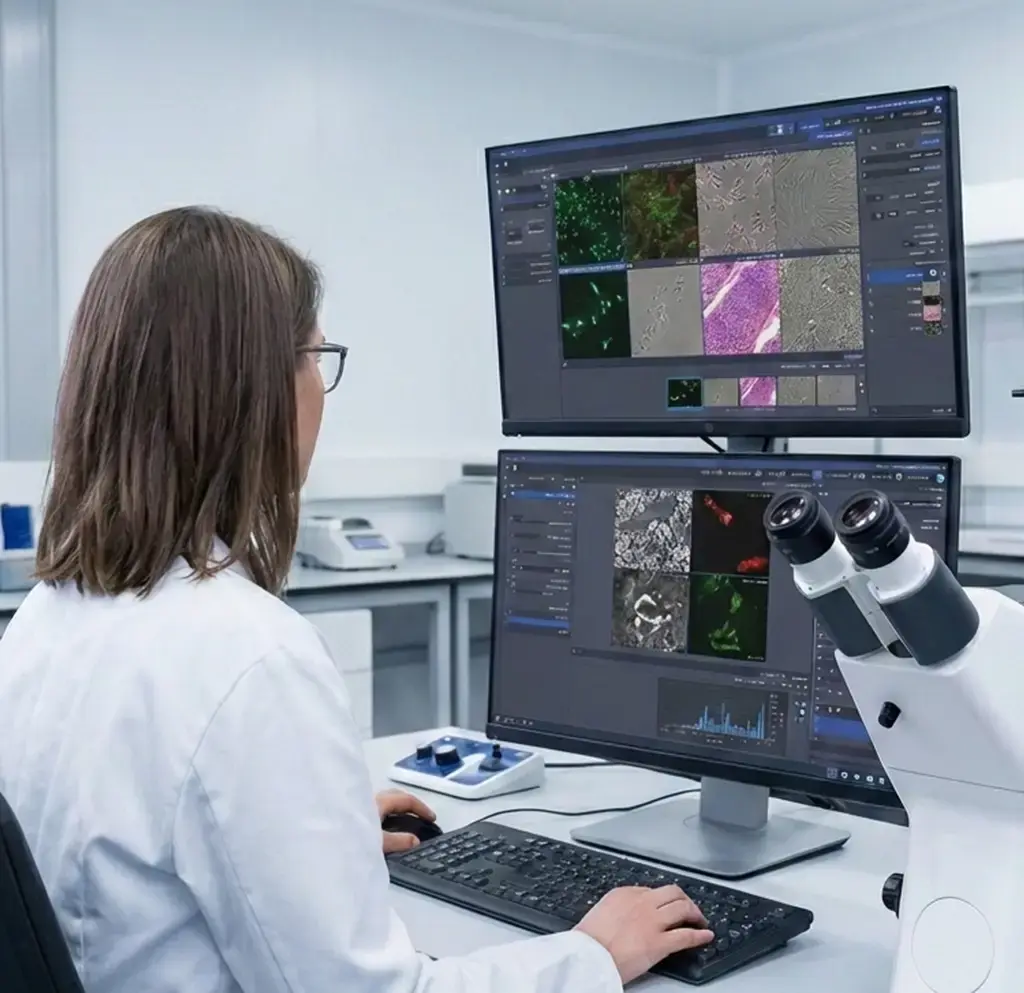
The ZEN platform is the core software solution on most imaging systems from ZEISS, supporting both routine workflows and advanced research experiments – from image acquisition and processing to visualisation and analysis. Over many years, ZEN has grown to more than four million lines of code and involves over 100 developers. This scale has increased complexity and made some large classes particularly challenging to manage.
Continuous modularisation and simplification of the platform are essential to improve testability and maintainability, and to further accelerate the pace of feature development. However, this is a high-effort and time-consuming undertaking.

Aiming to reduce code complexity while reducing manual refactoring overhead, Compass was used to help the team systematically identify refactoring opportunities within large classes. Over the course of five months, we focused on five use cases, comparing manually implemented solutions with AI-identified proposals and validating results with ZEISS SMEs. From the outset, we defined a structured approach and modernisation plan, covering the analysis, execution and validation phases, which proved critical to success.
The project was supported by Microsoft. Compass was deployed in ZEISS’s Azure environment and integrated with the Azure OpenAI service.
Now, with the pilot successfully completed, we are eager to share our learnings with other teams across ZEISS who may be facing similar challenges in software modernisation and exploring AI-driven efficiency.
Key learnings
- High-value strengths: Compass proved particularly effective in high-level code analysis, understanding business concepts, mapping workflows and dependencies, producing actionable backlogs, and creating step-by-step refactoring templates.
- Productivity gains: The use of AI led to measurable acceleration, including up to 5x faster issue detection, 5x backlog creation and 2x faster analysis, knowledge transfer and creation of solution proposals.
- Governance: To realise these productivity gains, a structured and guided approach is essential. While refactoring is an iterative process, establishing a clear modernisation plan before diving into detailed analysis was key to success.
Accommodating for risk
Like any AI solution, Compass comes with boundaries. Outputs must be validated, and context carefully set to ensure reliable results. Compass is not designed to write complex code or to map low-level dependencies.
Practical recommendations
- Start with high-level prompts, then drill down gradually
- Request fact-based analysis to reduce assumptions
- Use iterative follow-ups for refinement
- Fact-check and validate outputs with SMEs

Positive impacts unlocked and the path ahead
The pilot clearly showed that AI is a powerful enabler for software modernisation when applied carefully. It delivered measurable productivity improvements throughout the SDLC, helping the team identify refactoring opportunities, reduce technical debt, accelerate development and improve maintainability of the ZEN platform.
Building on this success, Endava and ZEISS Microscopy are discussing a scalable, repeatable modernisation process to systematically refactor selected high-impact areas of the ZEN platform. The approach suggests AI-assisted ‘refactoring pods’ combined with ZEISS SMEs to accelerate development while reducing manual refactoring overhead and ensuring high quality output.
Explore the industry
Healthcare and Life Sciences
Develop innovative solutions to enable a connected healthcare ecosystem and seamless patient journeys.